
Entertainment
Bison Kaalamaadan Review: When a Sports Film Becomes a Portrait of Caste, Rage, and Survival

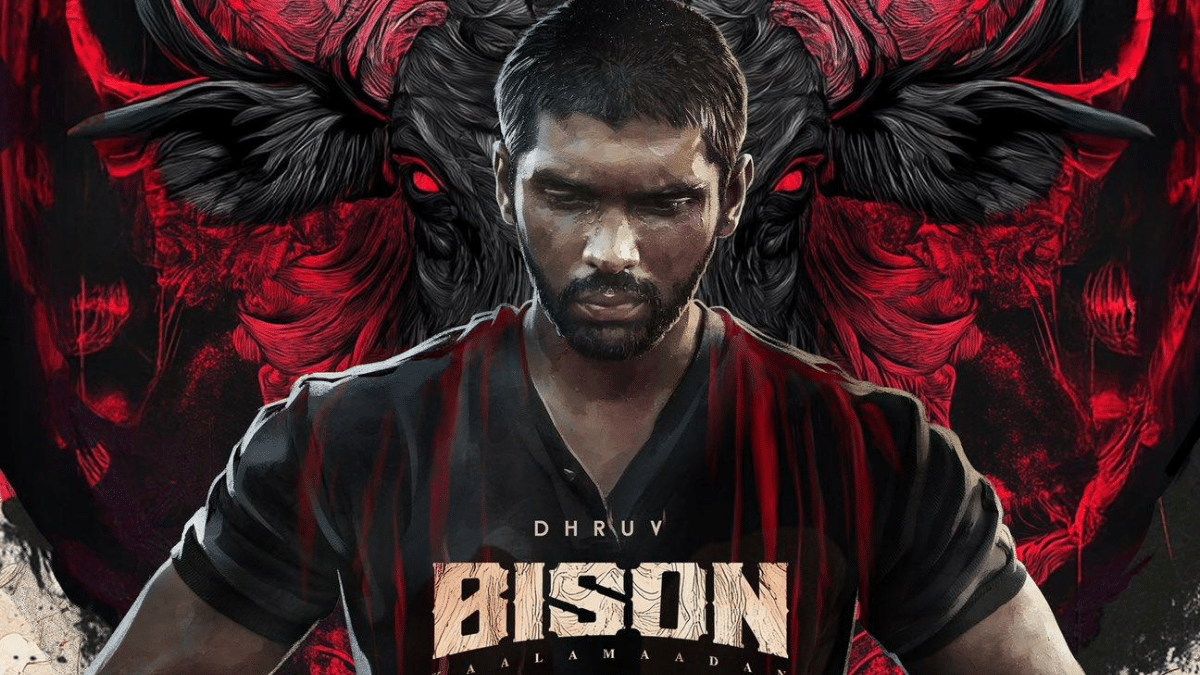
Sports films are inherently cinematic because struggle is built into the genre. Training, failure, discipline, rejection, comeback—yeh sab already melodrama ke ingredients hain. But when filmmakers like Mari Selvaraj and Pa Ranjith enter the sports-drama space, the story never remains limited to the individual athlete. The sport becomes a lens, and the film digs deep into society itself.
Bison Kaalamaadan, starring Dhruv Vikram, is not merely about Kabaddi or sporting glory. It is about what a body is allowed to do, who is permitted to dream, and how much violence a person is expected to absorb before being called “strong.”
A Striking Opening Rooted in Collective Waiting
The film opens with a grainy Doordarshan broadcast from 1994, during the Asian Games in Japan. An entire village waits anxiously for news of a Kabaddi match. Their local hero, Kittan, is part of the squad—but once again, he’s benched.
This opening is deliberately frustrating. The flickering black-and-white visuals mirror both the technical instability of the broadcast and the emotional instability of Kittan’s life. The disappointment is collective. The waiting feels endless. And importantly, this is not a flashback—it is the present.
Colour as Memory, Not Nostalgia
When the film cuts to flashbacks, colour floods the screen. This inversion is crucial. Kittan’s past is not something faded or distant—it is sharp, alive, and constantly fuelling his present. His memories are not trauma he escapes from, but weight he carries forward.
Mari Selvaraj uses this visual language to make one thing clear: the past does not disappear just because time moves forward.
Inspired by a Real Life “Bison”
The story draws inspiration from real-life Kabaddi player Manathi Ganesan, nicknamed “Bison” because of his immense physical strength. But Selvaraj is not interested in a conventional biopic structure. Instead, he reimagines the emotional and social circumstances that shape a man long before he enters a stadium.
Kittan grows up marked by loss—his mother’s early death and a father paralysed by fear. His father believes survival itself is success. Like many Indian parents from marginalised backgrounds, he discourages visibility, ambition, and risk. Sports, in his eyes, are dangerous—not because of injury, but because they make a person visible.
A Life Pre-Ranked by Society
Through layered flashbacks, the film shows how Kittan’s value is constantly measured through rigid hierarchies. He is poor. He is Dalit. He speaks only Tamil. He is introverted. He has limited education. He has no mother.
In a society obsessed with ranking everything, Kittan’s existence is treated like a list of disadvantages rather than a human life. The film repeatedly asks: what chance does someone like him truly have?
Violence as Inherited Atmosphere
One of the film’s most unsettling elements is how normalised violence is in Kittan’s world. His village is trapped in an endless feud between two men—Pandiaraja and Kandasamy. The conflict has no ideological meaning left; it survives purely as habit.
Knives flash constantly. Murders erupt over trivial disagreements. Rage circulates freely, passed down like inheritance. As one teacher tells Kittan’s father, “Nobody knows whether we will pick up the knife, or whether time will hand it to us.”
This line captures the film’s core anxiety: violence is not chosen; it is often imposed.
Dhruv Vikram’s Controlled, Physical Performance
Dhruv Vikram delivers a deeply physical yet restrained performance. His Kittan is powerful, but terrified of that power. Every training sequence shows a man building strength while actively resisting the urge to use it destructively.
Whenever Kittan is denied something and cannot articulate his anger, he runs. Through streets. Across playgrounds. Along highways. Each run carries a different emotional texture—confusion, desperation, release. His life begins to resemble a Kabaddi match itself: every attempt to step “out” is met with people dragging him back in.
Heavy-Handed Messaging and Narrative Excess
The film is not subtle about its themes. The background score often underlines emotions aggressively. Dialogue occasionally spells out ideas that the visuals have already communicated. The long runtime gives space for repetition, and not all of it is necessary.
A particularly indulgent scene involves Kandasamy delivering a mythological, sermon-like monologue in an empty field. The constantly spinning camera tries to elevate the moment, but the emotional payoff doesn’t fully land.
Weak Female Character Arcs
One of the film’s major shortcomings is its treatment of women. Rajisha Vijayan’s Raji, Kittan’s sister, exists largely to support him. Anupama Parameswaran’s Rani loves him from childhood, but the relationship lacks depth and consequence.
Their presence feels symbolic rather than fully lived-in, which is disappointing in a film otherwise so attentive to social detail.
A Climactic Shift Toward the Mainstream
As the narrative returns to the Asian Games match, colour re-enters the frame—most notably through Indian flags waving in the crowd. The final match is India vs Pakistan, and the film’s language shifts. Hindi and Urdu dominate, the background score smooths out, and the moment is designed for nationalistic emotional resonance.
This pivot may work for some audiences and feel jarring for others. Selvaraj clearly wants to meet the mainstream where it is, without abandoning his politics entirely.
A Companion to Karnan and an Unfinished Battle
The film concludes around 1995, placing it in the same timeline and region as Karnan (2021). Together, these films underline a sobering truth: breaking caste hierarchies in India is never a single victory. It is an ongoing series of battles.
Small wins exist. Hope exists. But the struggle does not end.
Final Verdict
Bison Kaalamaadan is not a neat sports drama. It is messy, loud, uneven, and often overwhelming—much like the world it portrays. While its excesses hold it back from greatness, its ambition, politics, and emotional honesty make it an important film.
This is not just a story about a man learning to win. It is about a society deciding who is allowed to even enter the game.

Data Lake Security: Using Engineering Services to Keep Your Data Safe

Bison Kaalamaadan Review: When a Sports Film Becomes a Portrait of Caste, Rage, and Survival

Quiet Luxury: How Thoughtful Storage Elements Elevate the Status of a Wardrobe

Forbidden Pants: How Clothing Restrictions Shape Culture, Identity, and Society

Coquette Nails: The Rise of Soft Romance in Modern Nail Art

777 Angel Number Meaning: A Complete and In-Depth Guide

Sunday Kalogeras: TikTok Star, Biography, Age, Family, Career & Digital Success

Low Maintenance Short Layered Haircuts: The Complete Informative Guide for Easy Everyday Styling

White Nails: Health, Causes, Science, and Long-Term Nail Care Explained

January Nail Colors: A Complete Guide to Seasonal, Stylish, and Timeless Manicures
Data Lake Security: Using Engineering Services to Keep Your Data Safe
Bison Kaalamaadan Review: When a Sports Film Becomes a Portrait of Caste, Rage, and Survival
Quiet Luxury: How Thoughtful Storage Elements Elevate the Status of a Wardrobe
Forbidden Pants: How Clothing Restrictions Shape Culture, Identity, and Society
Coquette Nails: The Rise of Soft Romance in Modern Nail Art
777 Angel Number Meaning: A Complete and In-Depth Guide
Sunday Kalogeras: TikTok Star, Biography, Age, Family, Career & Digital Success
Low Maintenance Short Layered Haircuts: The Complete Informative Guide for Easy Everyday Styling
White Nails: Health, Causes, Science, and Long-Term Nail Care Explained
January Nail Colors: A Complete Guide to Seasonal, Stylish, and Timeless Manicures
-
 Security1 month ago
Data Lake Security: Using Engineering Services to Keep Your Data Safe
-
 Fashion3 months ago
Forbidden Pants: How Clothing Restrictions Shape Culture, Identity, and Society
-
 Lifestyle2 months ago
Quiet Luxury: How Thoughtful Storage Elements Elevate the Status of a Wardrobe
-
 Tech6 months ago
Preply Login: A Complete Guide for Students and Tutors